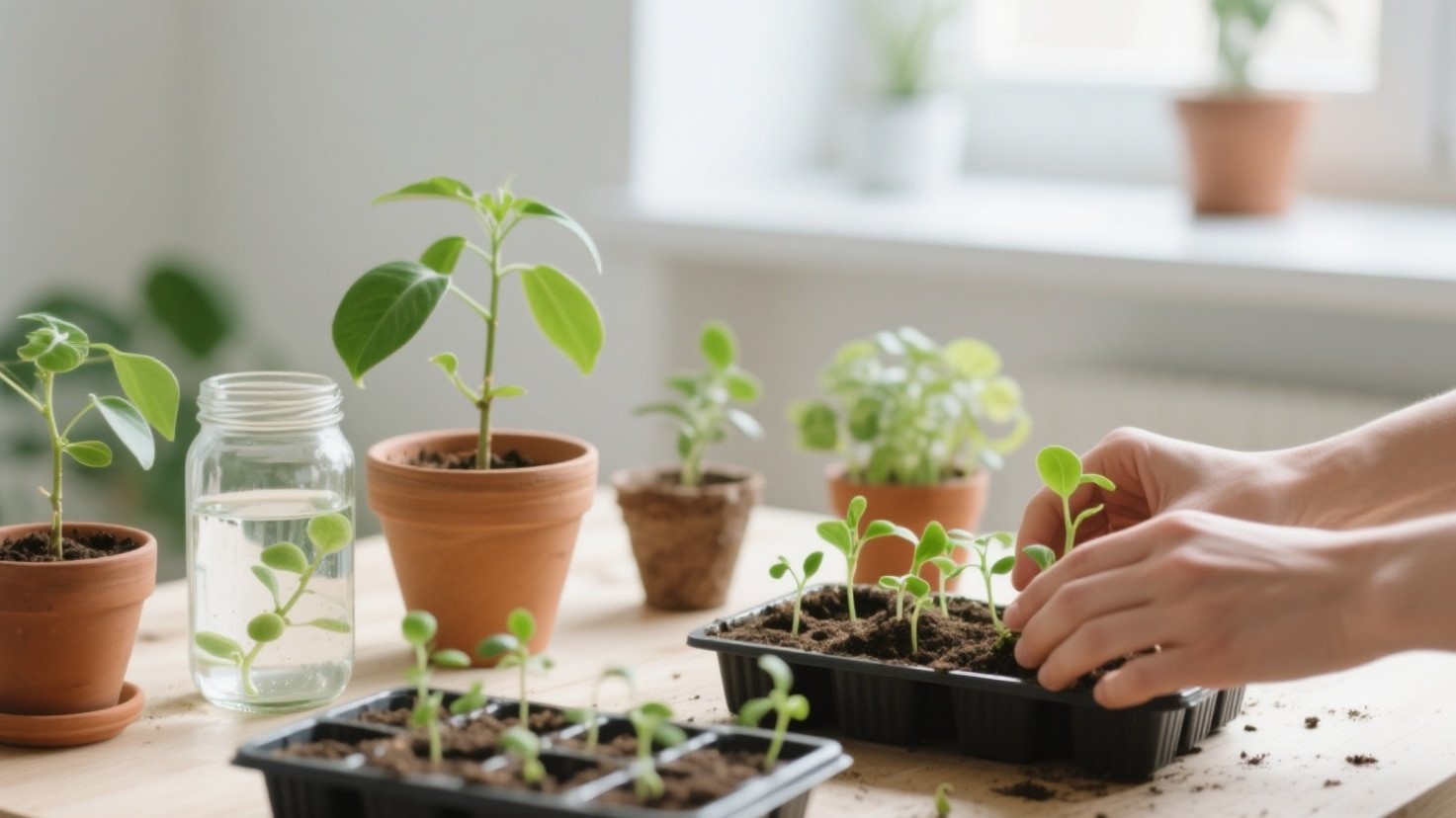

Every gardener eventually hears someone say, “Just propagate it—it’s faster!”
But if you’ve ever taken cuttings and waited… and waited… and waited… you already know the truth:
Propagation is not fast. It’s slow, deliberate biological development, and most of the process happens underground or inside the stem where you can’t see anything happening.
Many beginner gardeners quit after 2–4 weeks, assuming their cutting “failed” because they see no visible change. In reality, the cutting might be doing exactly what it’s supposed to do—and it’s simply following a timeline that biology sets, not us.
This article breaks down the realistic, evidence-based timeline of cuttings, what’s happening at each stage, and why propagation often takes longer than people expect.
🌿 Why Propagation Takes Time (Based on Actual Plant Biology)
Propagation by cuttings relies on processes such as:
- Callus formation
- Adventitious root initiation
- Cell differentiation
- Root elongation
These are well-documented biological mechanisms in plant physiology. They cannot be rushed, even with perfect conditions.
Plants do not “heal” instantly. They reorganize cells, redirect hormones (especially auxins), and slowly grow new tissues. That internal restructuring is invisible for weeks.
This is why experienced horticulturists repeat this one lesson:
Propagation success is mostly patience—not skill.
🌼 The Realistic Timeline of Cuttings
(Varies by species, but these ranges reflect widely observed horticultural norms.)
Below is a general, honest timeline for stem cuttings under typical household conditions—not greenhouse perfection.
📆 Stage 1: Wound Response & Callus Formation (Days 1–14)
After cutting the stem, the plant must protect itself.
What actually happens:
- The cut end seals to prevent moisture loss.
- A callus (a soft, protective tissue) forms.
- Plant hormones accumulate at the cut site.
- No roots yet—this is normal.
What beginners often mistake:
- “Nothing is happening.”
- “It must have failed.”
But at this stage, everything is happening internally.
This is the longest “invisible work” phase.
📆 Stage 2: Adventitious Root Initiation (Weeks 2–6+)
This is when roots begin to form inside the stem before emerging.
What’s happening now:
- Cells reorganize into root primordia (root “buds”).
- These baby roots grow internally until strong enough to push out.
Important:
You might not see roots until week 4, 6, or even 8, depending on the plant.
Examples of realistic timelines:
- Pothos: 2–4 weeks
- Rosemary: 4–8+ weeks
- Snake plant leaf cuttings: 8–12+ weeks
- Woody plants (e.g., figs): 4–10 weeks
Propagation is far from “quick.”
📆 Stage 3: Visible Root Emergence (Weeks 3–10+)
Now roots finally break through the stem or are visible in water.
What to expect:
- Slow, steady elongation
- Occasional browning or stalling
- Some cuttings may root in water faster than soil, but not always
Critical note:
Visible roots do not mean the cutting is ready for potting.
Roots need thickness, branching, and stability to survive soil transition.
📆 Stage 4: Root Strengthening & Energy Stabilization (Weeks 4–12+)
Once roots emerge, the plant shifts energy toward:
- Making secondary roots
- Thickening the root system
- Re-starting new leaf growth
This phase is crucial—and still slow.
Repotting too early is one of the top causes of propagation failure.
📆 Stage 5: First True Growth After Potting (1–3 Months After Rooting)
Most beginners assume a cutting will grow quickly once planted.
But the first month in soil is usually adaptation, not expansion.
Realistic expectation:
- First new leaf may take 4–8 weeks
- Rapid growth may not start until months after potting
Propagation isn’t just rooting—it’s rebuilding an entire plant system.
🌿 Why “Propagation Is Faster” Is a Myth
Propagation is only “fast” compared to growing from seed, not compared to buying a mature plant or letting an existing one naturally branch out.
Factually, propagation includes:
- Healing time
- Hormonal shifts
- Root initiation
- Root emergence
- Root strengthening
- Acclimation to soil
- New growth establishment
This is a months-long process.
Buying a plant or letting a healthy plant grow on its own is almost always faster.
Propagation is rewarding—but it’s not quick.
🌸 How to Avoid Feeling Like Your Cutting Is Failing
To prevent the discouragement that causes so many people to give up:
✅ Accept that visible progress takes weeks, not days
If you see nothing for 4–6 weeks, that’s normal.
✅ Don’t dig up soil cuttings to “check”
Every disturbance delays the rooting process.
✅ Log your cutting dates
You’ll see how long it actually takes—and you’ll feel more patient.
✅ Don’t overwater or oversaturate
Too much moisture causes rot faster than anything else.
✅ Keep expectations realistic
Propagation is slow, but deeply satisfying if you respect the timeline.
🌳 The Real Reason Propagation Matters (Even If It’s Slow)
Propagation teaches the most important gardening skill:
Understanding and respecting biological timelines.
Plants are slow. They are steady. And they do things on schedules that humans cannot speed up.
If you stay patient long enough, you’ll see the magic—but only if you don’t quit too soon.