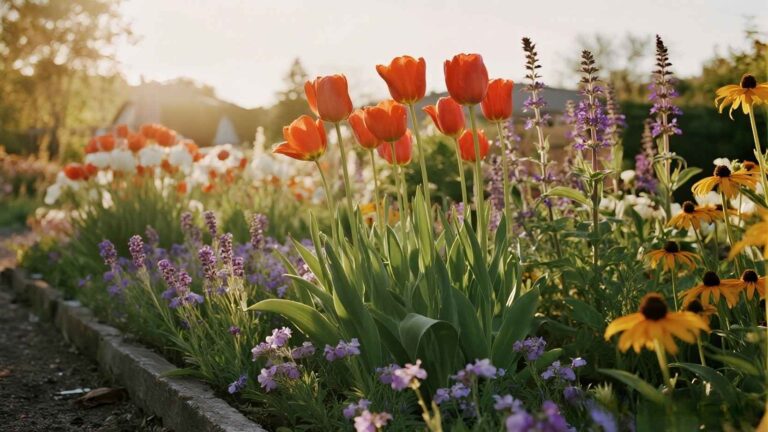
Introduction: Why Tulip Beds Need a Summer Backup 🌈
Tulips deliver a brilliant burst—and then the show fades just as the season begins. In Zone 5b, the key is stitching in perennials that wake up as tulips go quiet, so your border never looks “done” by June. Think of it like a relay race: bulbs hand the baton to early perennials, then to summer stalwarts that carry color to fall. 😊
This guide maps a month-by-month color calendar built from tried-and-true, long-bloom suggestions. You’ll get a quick maintenance checklist (deadheading, staking bee balm, dividing coneflower/coreopsis) to keep things tidy and flowering hard. We’ll finish with a mini buying list by shape—spikes, domes, and daisies—so your bed has contrast and rhythm. 🌿
Zone 5b Month-by-Month Color Calendar 📅
April: Tulip Peak & Early Carpets 🌸

April is your tulip crescendo; frame it with creeping phlox (Phlox subulata) at the front for a pastel mat under the blooms. Hellebores and early Brunnera add shade-friendly texture while tulips star in sun. Add species tulips and early alliums for a foreshadow of purple globes to come. 💜
Keep foliage pristine by avoiding overhead water during cool snaps, and tuck in evergreen heuchera for winter-to-spring continuity. If rabbits nibble, ring the bed with strong-scented herbs like thyme as a soft deterrent. Keep notes on which tulip varieties perennialize best in your soil—this pays off next fall.
May: Bridge the Gap with Blues & Purples 💙

As tulip petals fall, May brings salvia (’Caradonna’, ‘May Night’) and bearded iris—both echo tulip drama with tall lines. Allium ‘Purple Sensation’ fires now, punctuating the border with lollipop blooms. Nepeta (catmint) weaves a soft lavender haze that flatters fading tulip foliage. 🐱
Deadhead salvias promptly to trigger repeat bloom and keep the bridge alive into June. Edge the path with hardy geranium (e.g., ‘Rozanne’) for long season color. Let tulip foliage remain upright and unbraided; the leaves are refueling bulbs for next spring.
June: The Summer Switch-On 🌞

June is handoff month: peonies explode, catmint is full, and early coreopsis starts to flicker. If your palette leans hot, slide in geum and perennial dianthus for sparks among the blues. Fill small holes with annuals like verbena and sweet alyssum to carry fragrance. 🌼
Shear catmint by one-third after the first flush; it rebounds with tidy regrowth and more flowers. Stake bee balm now while stems are short to prevent flop later. Water deeply but infrequently to build drought-resilient roots before true heat arrives.
July: High-Summer Heat, High-Impact Color 🔥

July brings the showstoppers: coneflower (Echinacea), black-eyed Susan (Rudbeckia), and bee balm (Monarda). These daisy-forms read from a distance and invite pollinators, keeping the bed lively and loud. Thread in veronica or liatris spikes for contrast and vertical energy. 🐝
Watch for powdery mildew on bee balm; good spacing and morning watering help, and staking keeps clumps upright for photos. Deadhead coneflower lightly if you want extended bloom, or leave some seedheads for goldfinches. Coreopsis continues as a cheerful filler between larger clumps.
August: Color That Refuses to Quit ✨

When the lawn goes tired, your border can peak again. Russian sage (Perovskia/Salvia yangii) and ornamental grasses create a shimmering, drought-tolerant veil. Coreopsis, coneflower, and rudbeckia keep the daisy rhythm strong, while asters and sedum stage their entrance. 🌾
Cut back spent bee balm stalks and remove any floppy stems after storms. Divide overgrown coreopsis if flowering drops or centers die out; revitalized clumps bounce back quickly. Keep irrigation consistent in heatwaves to prevent bloom stall.
September: The Gentle Fade—But Still Blooming 🍂

Asters (’Purple Dome’, ‘October Skies’) and sedum (‘Autumn Joy’, ‘Matrona’) are your September anchors. Their cool purples and dusky pinks harmonize with tawny grasses and the architectural seedheads of echinacea. Tulip plans for fall planting can be made right now while gaps are obvious. 📝
Leave select seedheads for winter interest and birds; it’s beauty and habitat in one. If the border looks busy, mass a single aster variety for cohesion. Mark any underperformers for relocation when the soil cools.
Maintenance Checklist: Set It and (Mostly) Forget It 🧰

Deadhead: Shear nepeta after first flush; clip spent salvia wands to trigger repeat bloom; lightly deadhead coneflower if you prefer continuous color over seedheads. Staking: Install discreet hoop stakes or grid supports around bee balm in June to prevent flop and keep airflow high. Watering: Deep, infrequent soaks beat daily sprinkles; mulch 2–3 inches to retain moisture and suppress weeds. 💧
Dividing: Split coneflower and coreopsis every 2–3 years if centers “hollow out” or bloom wanes; replant vigorous outer fans. Hygiene: Remove mildew-covered leaves from bee balm and dispose (don’t compost if disease is heavy). Feeding: In average garden soil, a spring top-dress of compost is often plenty; avoid high-nitrogen feeds that push floppy growth.
Tulip Foliage Rule: 6–8 Weeks, No Braiding ✅
Leave tulip foliage intact for 6–8 weeks after bloom—it’s photosynthesizing to recharge bulbs. Don’t braid or rubber-band leaves; that reduces surface exposure and weakens next year’s show. Mask the fade with catmint, hardy geranium, or low heuchera so the bed stays pretty. 🌱
If foliage bothers you visually, plant in clumps behind emerging domes that conceal the yellowing leaves. Consider interplanting with alliums and salvias whose fresh growth distracts the eye. Mark varieties that perennialize well so you can repeat them in fall.
Mini Buying List by Plant Category 🛒
- Spikes (vertical accents): salvia (‘Caradonna’, ‘May Night’), veronica, liatris, lupine, foxglove (biennial), ornamental alliums. Spires pierce through domes and tulip foliage, giving structure before and after bloom. Choose a consistent spike color (e.g., purple) to unify mixed borders. ⬆️
- Domes/Mounds (soft volume): nepeta (catmint), hardy geranium (‘Rozanne’), heuchera, sedum (mound forms), brunnera for part shade. Domes cover ground, hide fading bulb leaves, and create calming “resting spaces” between spikes and daisies. Repeat the same dome plant every 3–5 feet for rhythm. ⭕
- Daisy-Forms (read from a distance): echinacea, rudbeckia, coreopsis, shasta daisy (Leucanthemum), asters (late season). These are your summer-to-fall exclamation points and pollinator magnets. Group in odd numbers (3–5) for impact and easier maintenance. 🌼
Quick Planting & Spacing Notes (Zone 5b) 🌱
Give salvias and veronicas 12–18 in (30–45 cm) spacing; nepeta and hardy geranium 18–24 in (45–60 cm). Echinacea and rudbeckia are happiest at 18–24 in with full sun and well-drained soil. Bee balm likes evenly moist soil and room for air—avoid cramming to reduce mildew. 🍃
Site alliums and liatris in the sunniest, best-drained pockets for strong stems. If your border is windy, cluster taller spikes behind a low hedge of domes for a natural windbreak. Keep labels: bloom time + height notes make fall bulb placement a breeze.
Conclusion: A Relay That Never Drops the Baton 🏁
Designing a tulip bed that never looks “over” is about choreography, not chance. With Zone 5b’s calendar—tulips to salvia/allium/iris, then catmint/peony, then coneflower/rudbeckia/bee balm, finishing with aster/sedum—you get color and texture for six months. The maintenance is light and predictable once supports, deadheading, and timely divisions are on your calendar. 💪
Start with one strong combo per month and repeat shapes—spikes, domes, daisies—for cohesion. Mask tulip die-back with mounds, keep water deep and steady, and choose plants that thrive in your microclimate. By next spring, your tulip bed will be a season-long showpiece—no dull gaps, just rolling color. 🎉