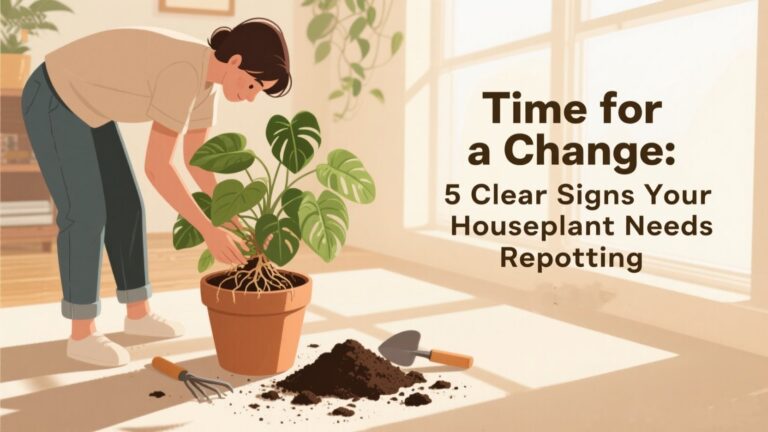
🌱 Introduction: Why Repotting Isn’t Just About Aesthetics

If your houseplants could talk, “I need more room!” might be the phrase you’d hear most often. Many plant owners assume that as long as a plant looks green, it’s happy — but beneath the soil, roots can be struggling, compacted, or suffocating.
Repotting isn’t just a cosmetic refresh — it’s an essential act of plant care that affects root health, moisture balance, and long-term growth. Yet, knowing when to repot can be tricky. Too early, and you risk stressing your plant; too late, and your plant could become root-bound, dehydrated, or nutrient-starved.
Reddit’s plant lovers from r/houseplants and r/plantclinic often discuss this dilemma. Many experienced gardeners say the secret isn’t in the calendar — it’s in the visual and tactile cues your plant gives you.
Let’s explore the five undeniable signs your plant is ready for a new home — along with a few tips from the Reddit gardening community to help your green friend transition smoothly. 🌿
🪴 1. Roots Are Escaping (Literally)
If you notice roots growing out of drainage holes, circling the soil surface, or peeking above the rim, your plant is officially root-bound.
🔍 Why This Happens
When a plant outgrows its pot, its roots start circling in tight loops. This restricts nutrient and water absorption, leading to slow growth and stress.
💡 Redditor Tip (r/houseplants):
“When you see roots circling the bottom like spaghetti, it’s time for a repot. Gently loosen them before placing in a new pot — don’t just plop it in.”
🌿 What To Do
Choose a pot 1–2 inches larger in diameter than the current one. Use fresh potting mix to provide new nutrients and space for expansion.
🌸 2. Water Drains Too Quickly (or Barely at All)
If your plant’s soil seems to dry out instantly after watering — or takes forever to absorb moisture — it’s a sign of compacted or exhausted soil.
🔍 Why This Happens
Old soil loses its structure over time. Compaction reduces aeration, while salts from fertilizers build up and interfere with drainage.
💧 Quick Check
Stick your finger two inches into the soil (the Reddit-famous “2-Finger Test”). If it feels dry and crumbly immediately, or dense and soggy, it’s time for a refresh.
🌿 What To Do
Replace the old soil with a fresh, well-draining potting mix appropriate for your plant type — cactus, tropical, or foliage.
🌼 3. Stunted Growth Despite Proper Care
Are you watering correctly, providing enough light, and still noticing no new growth? Your plant may have simply outgrown its space.
🔍 Why This Happens
When roots have no room to expand, they can’t absorb enough nutrients, no matter how much fertilizer you add. The plant’s energy shifts from growth to survival.
🌿 What To Do
Inspect the roots by gently removing the plant from its pot. If the root mass looks like a dense web and takes up most of the pot, it’s time to upsize.
🧠 Redditor Insight (r/plantclinic):
“Healthy plants that suddenly stop growing are sending a signal — check below the surface before you blame the light or watering.”
🍂 4. Yellowing Leaves and Frequent Wilting
When a plant’s roots are compressed or damaged, water distribution becomes inconsistent — leading to yellow, droopy, or crispy leaves.
🔍 Why This Happens
Overcrowded roots can’t absorb water efficiently. Sometimes, water just runs straight through, leaving the soil unevenly moist.
🌿 What To Do
Check for uneven moisture after watering. If only some areas of the soil stay damp, the roots may not be spreading properly. Repotting ensures balanced hydration and oxygen flow.
💧 Redditor Tip (r/indoorplants):
“If your leaves wilt even right after watering, your plant’s roots might be strangling each other. Repot — and trim off any mushy roots.”
🌻 5. The Pot Is Cracking — Or Your Plant Feels Top-Heavy
Sometimes, the signs are as physical as they are visual. A plant that leans, tips over, or bursts from its pot is well past due for a repot.
🔍 Why This Happens
As the root ball expands, it pushes against the pot walls. Clay or ceramic containers may even crack under pressure.
🌿 What To Do
Transfer your plant into a wider and deeper container to restore stability. When repotting, place the root ball slightly below the rim and fill with new soil.
🪴 Pro Tip:
Always water your plant after repotting — it helps settle the soil and reduce transplant shock.
🌱 Bonus: When Not to Repot
Repotting can be stressful for plants, especially during dormancy or blooming. Avoid repotting:
- ❄️ During winter dormancy (for most plants)
- 🌸 When flowers are in full bloom
- 🌤️ Right after major pruning or propagation
If unsure, wait until spring or early summer, when active growth resumes — the plant will recover faster.
💚 Final Thoughts: Repotting as Renewal, Not Rescue
Repotting is often seen as an emergency fix, but Reddit gardeners view it differently — it’s a renewal ritual. It’s about giving your plant a fresh start, space to grow, and nutrients to thrive.
By paying attention to tactile and visual cues — roots peeking out, sluggish growth, or uneven watering — you’ll know when your plant is asking for a bigger home. 🌿
Remember: repotting isn’t about forcing growth, but making space for it. 🪴✨